2017 Educational & Program Events
Updated SFO Airline Reference Guide 04/21/17
Airport Committee  Get the latest Airline Reference Guide by clicking here.
 |
Cinco de Mayo with Congresswoman Jackie Speier!
Events Committee 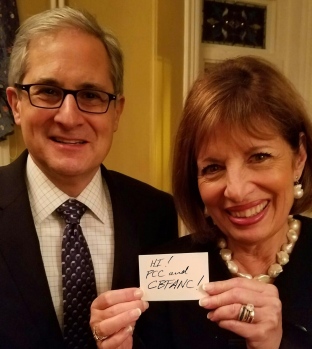 Our Man in D.C. Peter Friedmann & Congresswoman Jackie Speier
Photo Courtesy of Vincent Iacopella (Alba Wheels Up International)We can't wait to see you on May 5th (Cinco de Mayo!) with Congresswoman Jackie Speier! If you haven't signed up - hurry before it is too late! Register by clicking here.
CBFANC Ocean News
Ocean Committee From Port of San Francisco Customs and Border Protection Information Notice 728-17-08 dated April 12, 2017 announcing three Container Examination Site Applicants for Trade CES:
· Bobac C.F.S. Corp.
· PCC Logistics Inc.
· Summit CFS Inc.
Public comments are due by May 12, 2017 and may be sent to:
US Customs and Border Protection
Attn: Area Port Director, San Francisco
555 Battery Street
San Francisco, CA 94111
Information Notice 728-17-08 and Trade CES Applicants as attached. CBFANC encourages its brokers and forwarders to take time to inform on this important exam site selection. As convenient option, comments can be emailed to info@cbfanc.org. Please email byMay 11, 2017 to ensure timely submission to CBP San Francisco by the May 12 th deadline.
From the Port of Oakland, Monday May 1st Holiday Gate Schedule. Please note the May Day dayshift closures for workstop meetings with nightshift open schedules.
Dear Port of Oakland Stakeholders:
Daytime cargo operations at the Port of Oakland will be suspended Monday, May 1, for the ILWU’s regular monthly Stop Work meeting. The meetings are provided for in the labor agreement covering U.S. West Coast ports. Stop Work meetings are usually conducted Thursday evenings the third week of each month. Oakland’s ILWU Local 10 requested a shift to May 1st. The Pacific Maritime Association, representing waterfront employers, approved the change.
Please see the attached May 1 gate schedule.
CSMS #17-000231 Reminder: Required Security Change for All ACE Portal Accounts
U.S. Customs & Border Protection
Date: 4/21/2017 8:08:07 PM
To: Automated Broker Interface, ACE Outreach Events, ACE Portal Accounts, ACE Reports, Air Manifest, Export, New ACE Programming, Ocean Manifest, Rail Manifest, Truck Manifest
Federal Regulations require that sensitive data be protected when being disseminated over the
Internet. Transport Layer Security (TLS) is the government approved security mechanism to protect sensitive data during internet transmission. Currently, ACE supports versions 1.0, 1.1, and 1.2 of the TLS protocol.
On May 1, 2017, U.S. Customs and Border Protection (CBP) will discontinue supporting versions 1.0 and 1.1 of TLS. To comply with government regulations, all ACE Secure Data Portal users are being notified that CBP will be phasing out versions 1.0 and 1.1 of TLS and will only support version 1.2
Please note: The ACE Portal will not be accessible to users who operate computers that run operating systems older than Windows 7.
For more information about portal system requirements, please visit the “Using the ACE Secure Data Portal” page on CBP.gov/ACE, and scroll down to the bottom of the page. The page URL is: https://www.cbp.gov/trade/automated/getting-started/using-ace-secure-data-portal
CSMS #17-000242 - Perishable Good Indicator
U.S. Customs & Border Protection Services Date: 4/27/2017 11:34:32 AM
To: Automated Broker Interface, ACE Portal Accounts, New ACE Programming
On April 27, 2017, CBP deployed new functionality into the Cargo Release transaction: an optional Perishable Goods Indicator (PER). The purpose of this indicator is to provide the Trade filer the opportunity to electronically mark the Cargo Release submission as covering perishable merchandise. The presence of the PER indicator enables the CBP system to bring the shipment to the attention of CBP in the Port of Entry as “PERISHABLE”
When the Trade filer opts to submit the Perishable Goods Indicator, he does so as follows:
Submit “PER” in the SE20 record, Positions 5-7, Reference Identifier Qualifier.
Submit “Y” in the SE20 record, Positions 8-57, Reference Identifier. {input is left justified}
PER, Perishable Goods Indicator, is always optional. When the Reference Identifier Qualifier is PER, the Reference Identifier must always be a “Y” to indicate that this cargo release filing is for merchandise which is perishable.
**Please note that the submission of this indicator has no effect on the system processing of the Cargo Release transaction and its presence does not append or supersede existing CBP policy with respect to the handling of perishable shipments.
CBP will make an updated version of the ACE Cargo Release CATAIR.
New Requirements for Exports To, Through Hong Kong Further Clarified
Courtesy: Sandler, Travis & Rosenberg Trade Report The Bureau of Industry and Security has provided further information about a regulatory requirement that as of April 19 imposes new support documentation requirements on exports of specific controlled items to or through Hong Kong.
Under the newly effective regulation, exporters or reexporters must first obtain a copy of a valid Hong Kong import license (or a written statement from the Hong Kong government that an import license is not required, which may come in the form of a “no license required” notification) before exporting or reexporting to Hong Kong any item subject to the Export Administration Regulations and controlled on the Commerce Control List for national security, missile technology, nuclear nonproliferation, or chemical and biological weapons reasons. The exporter or reexporter must have the copy in its possession and the license must not have expired at the time of the shipment.
In addition, reexporters in Hong Kong must first obtain a Hong Kong export license (or a statement from the Hong Kong government that an export license is not required) before reexporting from Hong Kong any item subject to the EAR and controlled for NS, MT, NP column 1, or CB reasons. If a Hong Kong export license is issued, the shipment must be in accordance with the terms and during the validity period of that license.
BIS has recently updated a list of frequently-asked questions posted to its website (click here for highlights of the original list) to provide the following information about these requirements.
- A statement posted by the Hong Kong Trade and Industry Department on its website constitutes written guidance from the government of the Hong Kong Special Administrative Region to importers that no import license is required for imports of intangible technology into Hong Kong.
- If an item is merely transiting Hong Kong on its way to another destination and there is no consignee in Hong Kong, the item is considered to be an export or reexport to that destination. Hong Kong law may require the procurement of an import or export license for transit shipments but the U.S. requirement to get a copy of that license prior to shipment would not apply.
- Publicly available information found on HKTID’s website stating that no import license is required to import an item into Hong Kong is considered a copy of a written statement under the new rule. Records of an NLR notification or “website information” (in either hardcopy or softcopy) confirming the control status of the item in Hong Kong must be retained under the recordkeeping provisions of the rule. The NLR notification or website information may be used for more than one export or reexport to Hong Kong or more than one reexport from Hong Kong provided that the records are current.
Restrictions on Exports to Russia to be Further Eased
Courtesy: Sandler, Travis & Rosenberg Trade Report U.S. officials said recently they will soon move to further facilitate certain exports to Russia to ease an unintended impact on U.S. businesses from economic sanctions imposed by the U.S.
In January the Bureau of Industry and Security and the Office of Foreign Assets Control imposed sanctions against Russian entities that included a broad prohibition on engaging in transactions with, or providing technology to, Russia’s Federal Security Service (FSB) without U.S. government approval. The FSB is involved in reviewing and granting licenses, permits, and notifications for the importation of encryption items (which can include consumer items) into Russia, so the BIS/OFAC actions essentially prohibited U.S. companies from seeking the FSB approvals required to import such goods into Russia.
In February OFAC issued a general license allowing U.S. companies to work with the FSB to file required notifications or secure required import licenses. Specifically, the GL authorizes all transactions and activities otherwise prohibited pursuant to Executive Order 13694 that are necessary and ordinarily incident to requesting, receiving, utilizing, paying for, or dealing in licenses, permits, certifications, or notifications issued or registered by the FSB for the importation, distribution, or use of information technology products in Russia.
However, it has been a challenge for some U.S. exporters to take advantage of this GL because one of its conditions is that any item provided to the FSB must be in compliance with the Export Administration Regulations. Since the FSB is on the BIS’ Entity List, providing the FSB with the technical information necessary to file a notification or secure an import license (which is controlled under the EAR) requires an export license, but BIS reviews applications for such licenses with a presumption of denial.
Deputy Assistant Secretary of Commerce for Export Administration Matt Borman told a recent meeting of the BIS Regulations and Procedures Technical Advisory Committee that BIS plans to issue within the next few weeks a regulatory exception mirroring the OFAC GL. This exception would authorize the submission of otherwise restricted technical information to the FSB to file a required notification or secure a required import license.
Only such information that is not otherwise restricted for export to Russia would be authorized under this exception. Even so, said Sandler, Travis & Rosenberg export controls practice leader Steven Brotherton, the forthcoming exception is expected to be a significant benefit for U.S. exporters.
With Billions At Stake, Trump Agrees To Mend NAFTA — Not End It
Courtesy: NPR - Scott Horsley President Trump still calls the North American Free Trade Agreement "a horrible deal" for the United States. But in opting to renegotiate — rather than cancel — the agreement, Trump acknowledged that backing out of NAFTA would be "a pretty big shock to the system."
After more than two decades, NAFTA is tightly woven into the economies of the U.S., Canada and Mexico. Trade among the three countries is much more robust and supply chains more tightly integrated than was the case in 1994 when NAFTA went into effect.
Last year, Canada and Mexico were the United States' second- and third-largest trading partners, respectively. With hundreds of billions of dollars at stake, it's little wonder those countries' leaders pressed Trump not to abandon the trade agreement. To read article in its entirety click here.
|